
Labor
This chapter is limited to Danzer operations only.
(GRI 3-3, 401). In the wake of a financial downturn in 2019, Danzer downsized its operations and eliminated its corporate human resources function. Most of these indicators are managed on a local level. All locations have a human resources specialist who ensures that policies and procedures when it comes to general labor issues and metrics are compliant with local laws and address the local community and labor market situations.
Thus, the categories new employee hires and turnover (GRI 401-1), benefits to full-time not given to temp or part-time (GRI 401-2), and parental leave (GRI 401-3), and minimum notice periods (401-1) are not included in this report, but interested parties can inquire at the local Danzer human resources department.
Generally speaking, our Code of Conduct clearly states, “We are paid for our work, and we have health care and other benefits.” We explain to our colleagues that Danzer is particularly proud to maintain a high level of seniority in its workforce. Teamwork and a strong trust in workers create a positive environment to work in. At Danzer, we value the work of our employees and foster a stable and trustworthy working environment. Fair working conditions, appropriate compensation, and social protection form the foundation of long-term cooperation and mutual trust. Danzer operates in compliance with local legislation and strives to be a reliable and responsible employer in all countries where it operates.
The success of our commitment is evidenced by the fact that almost any promotion or succession can be filled with candidates from inside Danzer, who have been trained, and thus promoted from within the organization. Outside hires are the exception at Danzer.
Equal Opportunity
(GRI 405, 406, 3-3). Danzer demands that all employees adhere to the Code of Conduct which supports a universal commitment to non-discrimination in employment meaning simply that employees are selected on the basis of their ability to do the job and that there is no distinction, exclusion or preference made on other grounds. Employees who experience discrimination at work are denied opportunities and have their basic human rights infringed. This affects the individual concerned and negatively influences the greater contribution that they might make to society. (UNGC)
At Danzer, we understand that discrimination can take many forms, both in terms of gaining access to employment and in the treatment of employees once they are in work. Among our six Danzer values is, “We Trust,” which clearly states, “we are proud of the diversity of our people.” Any discrimination would be contrary to this value and our Code of Conduct.
Incidents of discrimination
(GRI 406-1). No incidents of discrimination have been reported through the Danzer hotline (Danzer Grievience Mechanism and Integrity Line) such that a report in the Corrective Actions Database would have been triggered. It is possible that complaints were handled at stage 1, on a confidential level between supervision, human resources, and/or management. Based on the procedure, nothing escalated to a hotline report.
Labor relations
(GRI 402, 3-3). At Danzer, we understand that the employee experience influences culture, adaptability, quality, consistency and overall success. We value the high seniority we enjoy among our colleagues. At the time of this report, no Danzer location is unionized. Danzer prefers to handle employee concerns directly, with greater efficiency than an external representative could do.
Freedom of Association and collective bargaining
(GRI 407, 3-3), (GRI 2-30, 407). Danzer values employee communication and participation. We support our environmental and safety teams in regular meetings to discuss workplace improvements. Our Code of Conduct makes it clear that, “We’re free to meet to discuss making a better workplace,” as explained in employee training, “Freedom of association means that employees have the right to freely join professional organizations or other employee representative bodies, or to choose not to do so. Employees may also freely elect their representatives, including representatives in the field of occupational health and safety. Danzer fully respects these rights and supports open communication and employee participation.”
Child / Forced Labor
(GRI 408, 409-1, 3-3). Danzer does not employ persons who are not of legal age and/or forced to labor. The Danzer Code of Conduct makes this clear, “We only employ individuals who meet legal requirements and work voluntarily,” and further explains, “We do not tolerate child or forced-labor in Danzer’s or suppliers’ operations. The minimum age of hire for Danzer employment is, according to local law, the same as the end of compulsory education - except in the case of student interns who are hired according to local employment law, but never below the age of 15.”
Further, Danzer’s Due Diligence aims to keep any such coerced labor out of the value chain.
Working Conditions
(GRI 403). Working conditions at Danzer cannot be called “comfortable” for all workers. We work with a natural material in a manufacturing environment that exposes workers to the outdoor elements sometimes, and, especially in the heat of the Summer, indoor elements. We monitor wood dust and noise as well as chemical exposure where necessary and install the best available technological controls.
Worker Safety
(GRI 403, 3-3). Two of Danzer’s Objectives and Key Results are linked to Worker Safety:
Fewer (<) Injuries and More (+) Training.
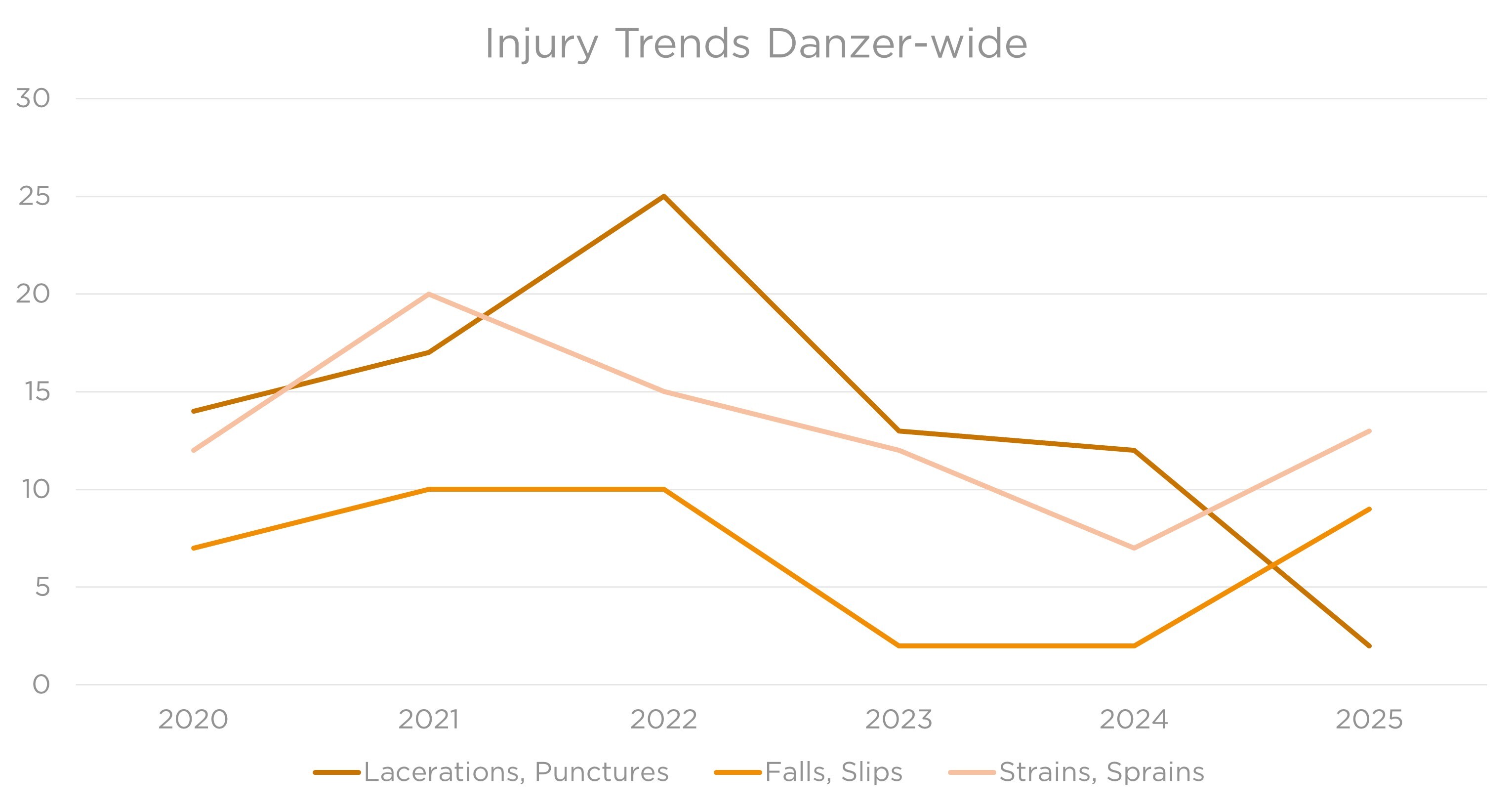
Aiming to improve on their 2024 achievements of 20% less injuries in the top occurring injury categories and 27% less lost time injuries across Danzer, the (<) Injuries OKR team set goals for 2025 to continue this trend by adding a quality component: measure safe behaviors related to the top injury categories (lacerations, strains, slips and falls). We met this goal with a 21% decrease in top categories across Danzer locations: lost time injuries remained steady but the number of restricted work injuries increased by almost 40% because of 2 cases, and the number of lost work days due to injury increased 22% due to one case. Individual locations saw significant improvements. The safe behavior metrics and measuring tools continue to be developed, testing different methods among locations.
Safety Management System
(GRI 403-1). In 2025 the North American and Czech operations began the process of preparing the safety component of our well-established Environmental and Safety Management System (ESMS) for 3rd party certification to the ISO45001 standard. The ESMS utilized by all Danzer manufacturing operations is based, since 1994, on the ISO framework of PLAN, DO, CHECK, ACT. Third party audits and certification results are anticipated in 2026.
Hazard ID, risk assessment, incident investigation
(GRI 403-2). The Danzer ESMS is designed according to the ISO standard of Plan, Do, Check, Act and includes: hazard identification, risk assessment, and incident investigation in the form of safety inspections, reports, and incident investigations. We use internal databases to track corrective actions in the form of reports that are circulated to track closure and meeting minutes. All facilities conduct incident investigations and report according to local safety regulations.
Occupational health services
(GRI 403-3). Danzer’s locations may expose employees to higher levels of wood dust and noise, and in some cases chemicals (formaldehyde (urea-glues) and isocyanate (PU-glue)). Work areas are monitored as required by local laws and regulations to ensure a safe working environment is maintained by filters, ventilation and/or personal protective equipment where the exposure demands this. Regular health checks of the employees are organized by the Human Resources department as required by exposure guidelines.
Worker participation in the OH&S is essential
(GRI 403-4). ESMS teams are present at all manufacturing and warehouse locations. All Pennsylvania locations maintain safety team certifications from the Pennsylvania Department of Labor and Industry.
Promotion of worker health is voluntary and specific to the location as health care systems vary widely.
(GRI 403-6). For examples: in the United States, employees voluntarily participate in wellness screenings to personally achieve lower insurance premiums; in Germany, many employees bike to work, certain health screenings are offered to every employee, flu shots are offered, a weekly fruit basket encourages healthy snacking, and from time to time, information sessions in collaboration with health insurance providers on topics such as nutrition, exercise, and preventing back pain.
Workers covered by an Occupational Health & Safety management system (GRI 403-8)
|
Location |
Number of FTEs as of 31. Dec. 2026 |
|
Kesselsdorf |
67 |
|
Melnik |
423 |
|
Raspenava |
47 |
|
Grödig |
28 |
|
Maldon |
16 |
|
Edinburgh |
186 |
|
Williamsport |
82 |
|
Darlington |
98 |
|
Shade Gap |
138 |
|
Durham |
19 |
Work-related injuries – illness
(GRI 403-9, 403-10). The international standard for reporting work related injuries is the Lost Time Injury Frequency Rate (LTIFR). The calculation skews smaller facilities in a bad light (# lost time injuries * 1E6 / total hours worked in the year). See the table below.
|
Location |
LTIFR |
|
Kesselsdorf |
10 |
|
Melnik |
15.3 |
|
Raspenava |
0 lost time injuries |
|
Grödig |
0 lost time injuries |
|
Maldon |
0 lost time injuries |
|
Edinburgh |
0 lost time injuries |
|
Williamsport |
1 lost time injury (no LTIFR) |
|
Darlington |
31.0 |
|
Shade Gap |
29.8 |
|
Durham |
0 lost time injuries |
For this reason, Danzer prefers to focus on using metrics that measure injury categories and safe behaviors (See section Worker Safety).
Training and Education
Worker training on OH&S
(GRI 404, 3-3), (GRI 403-5). At the same time the (<) Injuries OKR team was working on metrics, (+) Training OKR team worked together to utilize recordkeeping software unique to each region/language while developing new training programs for orientation. In July of 2026, a tool for interactive computer learning on Danzer policies and procedures will be launched for orientation and refresher training. The first subjects will be Emergency Action Plans, Code of Conduct, and the Grievance Mechanism. No training metrics were prepared for the 2025 reporting period because the implementation of the recordkeeping software packages was not coordinated to start at the same time. Each Human Resources department maintains local records.
Average hours of training per year per employee
(GRI 404-1). Due to unsynchronized implementation of the recordkeeping software packages across Danzer facilities, no training metrics were prepared for the 2025 reporting period. Each Human Resources department maintains local records.
Programs for upgrading skills
(GRI 404-2). The crucial know-how in the hardwood slicing business, from procurement to production to sales, is not taught in any formal education program in any country Danzer operates in. The uniqueness of on-the-job learning makes Danzer keen to promote from within. The manufacturing floor is a center to recruit supervisory and management positions. In fact, the majority of current Executive Board members were promoted from within Danzer as well as everyone in the second level of management with the exception of a few administrative management positions. Even our Environmental Safety and Management System recruited enthusiastic colleagues from the factory floor and witnessed them rise up with their responsibilities and even transfer to other departments like human resources and product management. Specialized training is also required for fields like engineering, safety, environment, human resources, and first aid. Danzer on occasion finances the education for individuals who are interested in pursuing these skill sets.
Employees’ performance and career development reviews (GRI 404-3) are designed at the local level and may include performance improvement plans to identify gaps or weaknesses in job performance and discuss plans for improvement within a certain time frame. Inquiries should be directed to the appropriate local Human Resources department.
Local Communities
(GRI 413, 3-3). Engagement, impact assessment and development (GRI 413-1,2) with local communities is important to Danzer operations.
For example:
In the Czech Republic, Danzer actively engages with local communities, particularly through cooperation with nearby municipalities and by organizing site visits for the public and schools. These activities contribute to open communication and help strengthen relationships with the local community. Danzer also supports local associations, particularly volunteer fire brigades.
In the United States, the annual food drive is often the first sign that the season of giving has arrived. The North American locations join forces for good, departments rally together to collect money from staff and shop (volunteer time) for the coalition . The location that collects this highest average item per employee, wins a pizza party.
In 2025:
|
Location |
Employees |
Items Collections |
Items Per Person |
|
Shade Gap |
33 |
812 |
25 |
|
Darlington |
95 |
1657 |
17 |
|
Edinburgh |
183 |
1778 |
10 |
|
Williamsport |
85 |
90 |
1 |
Alongside the food drive, the Darlington office has sponsored an Angel Tree for the past 13 years: 12 tags are placed on the tree with specific holiday wishes from local children in need (a warm coat, a toy, a book, a pair of shoes). The children who benefit are in local foster care.
Potential impacts of operations on surrounding communities (e.g. noise or dust) are managed in compliance with applicable legislation, are regularly monitored and complaints are responded to.
In Edinburgh, Indiana the local water authority brought their concerns to Danzer in 2024 about significant color levels in the discharge from the vat process. An engagement with the town and a reputable engineering firm began, a solution was proposed. As of March 2026, the Town is evaluating the proposal for an environmental treatment system designed to require little power, few chemicals because it relies on natural filtration and biological activity by gravel, plants and microorganisms.